
How to Restore Hardwood Doors Properly
- Gary Wilson
- 1 day ago
- 6 min read

A weathered hardwood front door changes the whole impression of a property. Even a well-kept home can look tired if the timber is faded, peeling, greyed by sun and rain, or marked by years of daily use. If you are looking into how to restore hardwood doors, the goal is not simply to make the surface look better for a few weeks. It is to bring back depth of colour, protect the timber properly, and achieve a finish that still looks smart after another run of Irish weather.
Hardwood doors are worth restoring well. Good timber has character, weight and natural detail that painted or composite alternatives rarely match. But exterior hardwood is exposed to everything - UV light, moisture, temperature swings, airborne dirt and repeated handling. That means restoration is part cosmetic, part protective maintenance. Done badly, the finish can fail quickly. Done properly, the door keeps its presence and performs as it should.
How to restore hardwood doors without cutting corners
The biggest mistake is treating restoration like a quick sanding job followed by a coat of whatever product is on hand. Exterior hardwood needs a system, not a shortcut. The exact process depends on the species of timber, the condition of the existing finish and how exposed the entrance is, but the principles stay the same.
Start by assessing the door honestly. If the finish is lightly dulled and intact in most areas, a maintenance restoration may be enough. If coatings are flaking, the colour has gone patchy, water is soaking into the timber or black staining is visible around joints and mouldings, the door will usually need to be taken back much further.
That early assessment matters because over-sanding a door in decent condition can create unnecessary work, while under-preparing a badly failed finish almost guarantees another failure.
Check the timber before you start
Look closely at the bottom rail, panel edges, glazing beads and any area around ironmongery. These are the places where moisture tends to sit. Surface discolouration is common and often recoverable, but soft timber, movement in joints or deeper splitting may point to repairs rather than straightforward refinishing.
If the door has warped, has significant water ingress or the veneer is failing on an engineered hardwood door, restoration becomes more specialist. At that point, preserving the appearance and weather resistance may involve joinery repair as well as decorative finishing.
Preparation is where the finish is won
Before sanding begins, remove handles, knockers, letter plates and as much hardware as practical. Masking around fittings can save time in the moment, but it rarely produces the same clean result. A premium finish relies on crisp detail.
The surface then needs to be cleaned thoroughly. Dirt, polish residue, traffic film and old waxes can interfere with sanding and adhesion. A proper clean also shows the true condition of the existing coating. Sometimes what looks like total failure is partly surface contamination. Other times, cleaning reveals widespread breakdown that was hidden under grime.
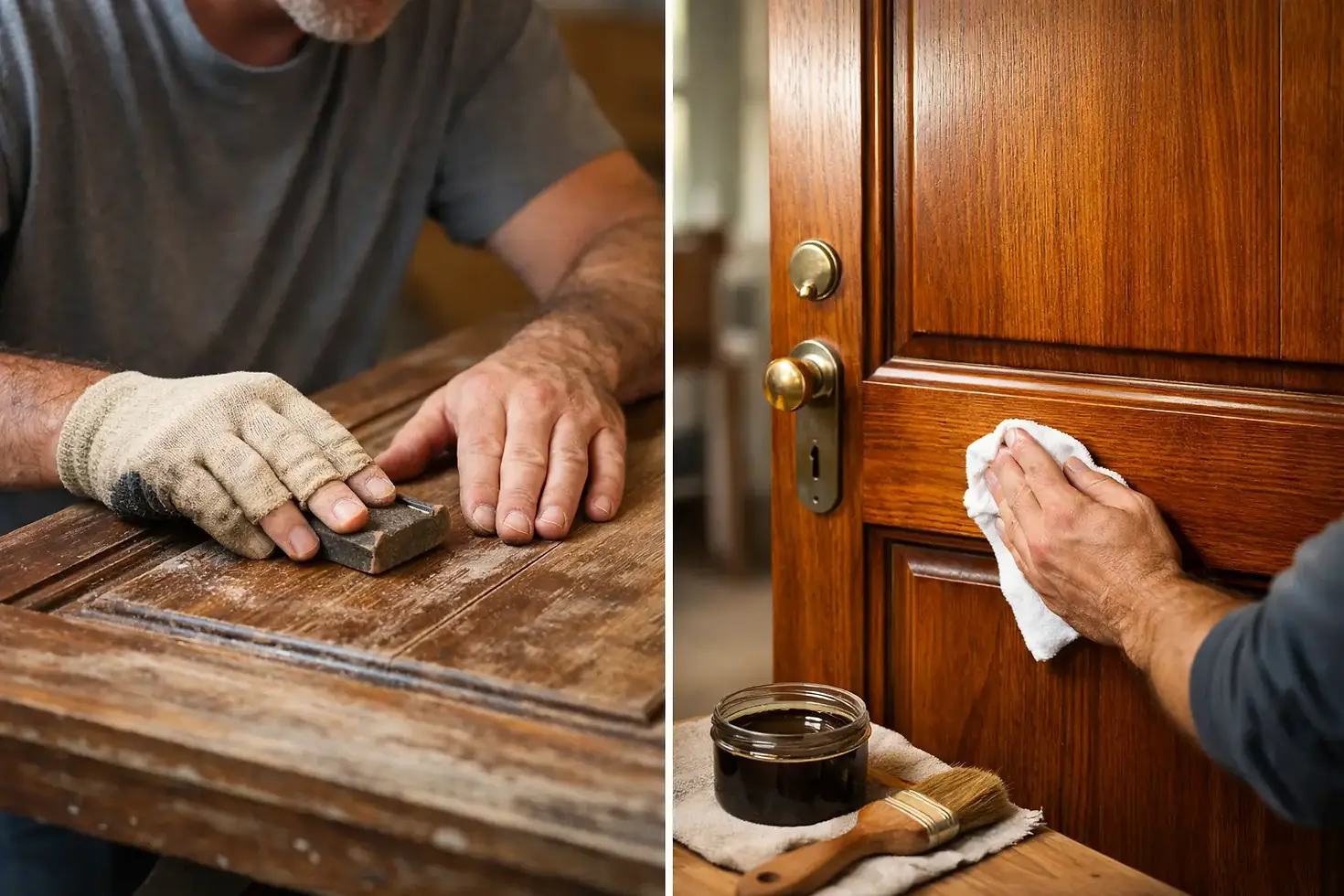
Once dry, failed coatings should be stripped or sanded back methodically. Flat areas are relatively straightforward, but mouldings and detailed profiles require patience. Aggressive sanding can round sharp edges and remove the definition that gives a hardwood door its quality appearance. The aim is to remove unsound finish while preserving the character of the joinery.
Sanding needs control, not speed
Sanding should progress through sensible grades rather than jumping straight to a very fine paper. Coarser abrasives remove breakdown and staining, while finer grades refine the surface for staining or clear finishing. The right sequence depends on how damaged the timber is, but the principle is simple: get the door clean and even without polishing the surface so much that the next coating struggles to key.
Always sand with the grain where possible, especially on visible sections. Cross-grain scratching may seem minor before coating, but once stain or varnish is applied, those marks can stand out sharply in daylight.
Stain, oil or varnish - choosing the right finish
One of the most common questions around how to restore hardwood doors is which finish gives the best result. There is no universal answer. It depends on appearance, exposure and maintenance expectations.
A stain-and-varnish system can work very well where a richer, more formal finish is wanted. Stain helps even out colour variation and restore warmth, while a high-quality exterior clear coat adds protection and depth. The advantage is visual richness. The trade-off is that when clear coats fail, they can peel and usually require more involved maintenance.
Exterior oils offer a more natural look and can be easier to maintain in the long term. Rather than sitting as a hard film on top, they tend to nourish the timber and weather more gradually. The appearance is often more understated and tactile. The trade-off is that they may need more frequent top-ups, especially on highly exposed elevations.
Some hardwoods also react differently to certain products. Dense timbers can resist absorption, while previous coatings may affect how evenly new stain takes. That is why test areas matter. On a premium entrance door, guessing is not good enough.
Colour choice affects more than appearance
Darker tones often look striking and can suit period and contemporary properties alike, but they absorb more heat. On a south-facing entrance, that extra heat can place greater stress on coatings. Lighter or mid-toned finishes may weather more evenly in difficult positions.
The surrounding architecture matters too. A hardwood door should feel in keeping with the property, not isolated from it. Brick tone, render colour, ironmongery finish and even porch depth all influence what will look right over time.
Applying the finish properly
Once the timber is clean, smooth and dust-free, the finishing coats need to be applied in the correct conditions. This is where many DIY attempts fall short. Direct sun, damp air, low temperatures and rushing between coats can all compromise the result.
Exterior door products need adequate drying time and proper film build. Too little product leaves the timber under-protected. Too much can cause sagging, slow curing or a heavy-looking finish that hides the grain. Fine sanding between coats may be needed to keep the surface smooth and refined, especially with varnish systems.
Edges, top and bottom sections, panel recesses and glazing details need the same attention as the front face. These are not secondary areas. They are often the first points of moisture entry. Skipping them shortens the life of the whole restoration.
If the door is removed for finishing, it can be coated more evenly and thoroughly. If it must stay in place, timing and weather protection become more important. Either way, good restoration is controlled work, not rushed work.
Common problems during hardwood door restoration
Even with careful preparation, some issues only become obvious once the old finish is stripped back. Water marks, sun bleaching, patchy colour and tannin staining are all common. Some can be sanded out. Others need specialist treatment or acceptance that the door will retain some natural variation.
That is not always a fault. Timber is a living material, and a beautifully restored door should still look like wood rather than plastic. The goal is a refined, well-protected appearance, not an artificial uniformity.
Another frequent issue is coating failure around glazing and panels. These areas move slightly with changing temperatures and moisture levels. Using the wrong product, or building up coatings too heavily, can lead to cracking. Flexibility and compatibility matter as much as appearance.
How often should a hardwood door be restored?
There is no fixed calendar because exposure varies so much. A sheltered door beneath a deep porch may only need light maintenance after several years. A fully exposed coastal or south-facing door may show wear much sooner.
The key is to act before full failure. If the sheen is dulling, colour is fading or water no longer beads on the surface, that is usually the point for maintenance. Leaving it until the coating peels or the timber greys out often turns a simpler refresh into a more labour-intensive restoration.
For quality-conscious homeowners, regular inspection is part of protecting the investment. A hardwood front door is a feature in its own right. Looking after it preserves kerb appeal, but it also helps avoid avoidable joinery deterioration.
When professional restoration is the better choice
A straightforward tidy-up may suit a lightly weathered door, but full restoration is different. Stripping failed finishes, correcting uneven colour, selecting compatible products and applying them to a high standard takes judgement as much as effort. On prominent entrance doors, that judgement shows in the final result.
This is especially true for larger properties, period homes and design-led refurbishments where the front entrance sets expectations. A poor finish stands out immediately. A well-restored hardwood door, by contrast, feels right the moment you approach it - crisp detail, rich tone, smooth protection and no shortcuts visible.
At Vision Painting & Decorating, that level of finish comes from meticulous preparation and product selection, not guesswork. Because with exterior timber, lasting results are rarely about one coat. They come from respecting the material and finishing it properly.
If your hardwood door still has solid timber beneath the wear, restoration is usually worth it. Done with care, it does more than tidy the entrance. It restores the sense of quality your property should convey every time someone arrives at the door.


Comments